Nalgene Survived BPA.
Microplastics Are a Different Problem.
There's a bottle sitting on my desk right now that I've had for six years. Covered in stickers, scratched up, still doesn't leak. It's a Nalgene. And if you've spent any time in the outdoors, on a college campus, or near anyone who takes their health seriously, you probably know exactly what I'm talking about.
Nalgene is one of those rare brands that became a cultural artifact without really trying to. They didn't have a massive marketing budget or a celebrity endorsement strategy. They had a good product, a compelling origin story, and seventy-five years of accumulated trust. That trust is now under pressure in a way it hasn't been since 2008, and this time, the playbook that saved them then won't work.
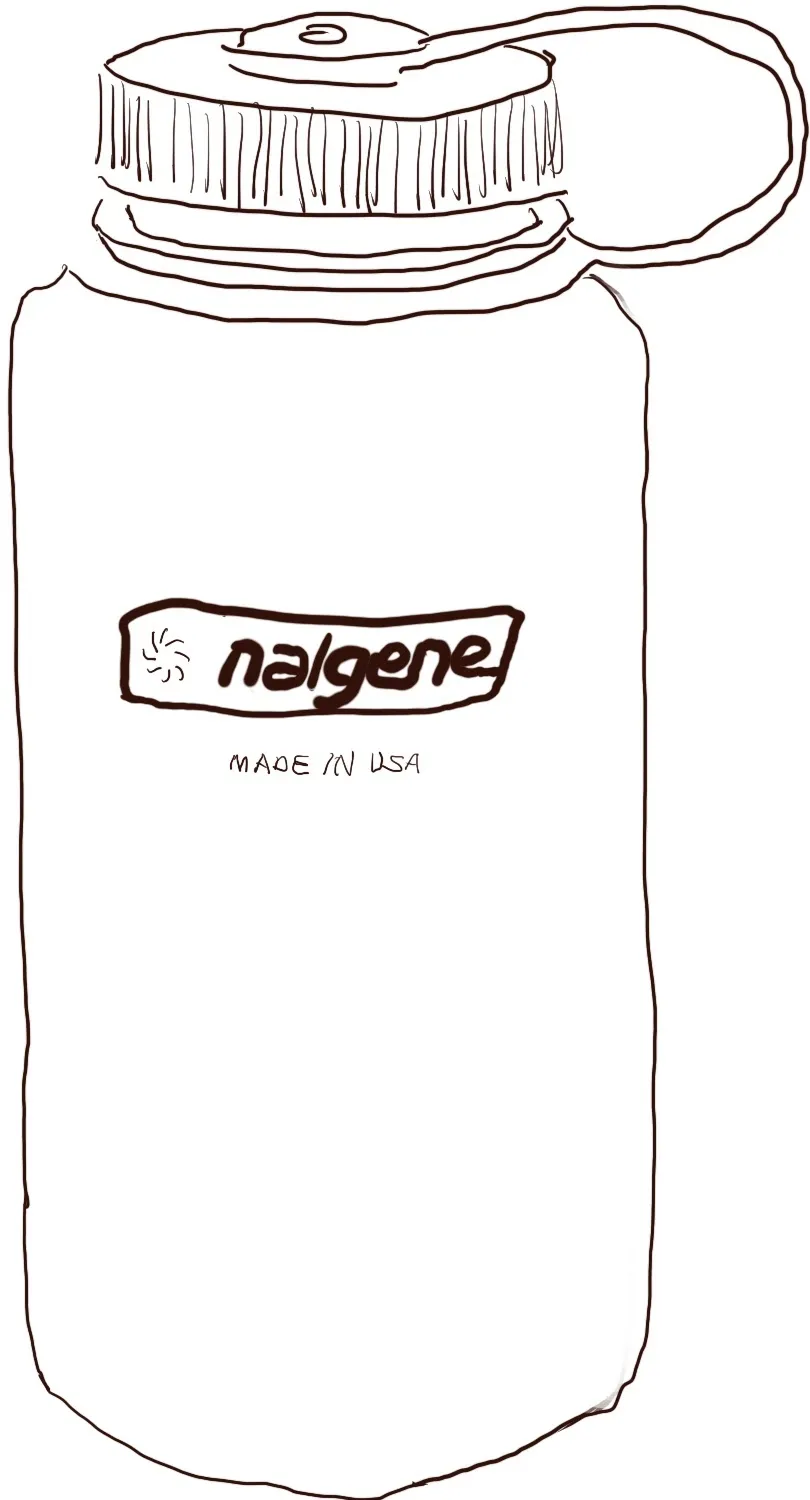
How They Got Here
Nalgene didn't start as a water bottle company. It started in a chemistry lab in Rochester, New York in 1949, making plastic containers for scientists who needed something lightweight and unbreakable in the field. [1] Hikers noticed. Outdoor retailers noticed. By the 1970s, the "original reusable water bottle" had found its market, not through advertising, but because scientists who happened to go camping brought their lab bottles with them.
That origin matters. Being born from science isn't just a tagline. It's the foundation of everything the brand stands for. Durable. Practical. Trusted. Made in America. For decades, that foundation held.
Then came BPA.
In 2008, the National Toxicology Program flagged bisphenol A (the chemical compound in Nalgene's polycarbonate bottles) as a cause for concern after animal studies showed elevated rates of cancer and hormonal disruption at exposure levels comparable to what humans typically encounter. [2] Walmart and Nalgene both announced plans to phase out BPA products within days of the report. Retailers pulled stock. Consumers panicked. It looked like the kind of crisis that ends brands.
But Nalgene adapted. They reformulated entirely, switching to a new BPA-free plastic called Tritan, and later introduced a Sustain line made from 50% certified recycled content. [3] The brand survived. Most people moved on. And for the next decade and a half, Nalgene grew quietly, still the bottle that built the category, still dominant on trails and in gyms, still the OG that Target's own hydration buyer cited as the reason they built out their water bottle aisle in the first place. [8]
That story of resilience is now being used as a template for how Nalgene should respond to microplastics. And that's exactly the wrong lesson to take from it.
The Science People Are Scared Of
To understand the strategic challenge, you first have to understand why the microplastics conversation is different in kind, not just in degree, from what came before.
Stanford Medicine's Plastics and Health Working Group describes microplastics as genuinely inescapable: an estimated 10 to 40 million metric tons of plastic particles are released into the environment every year, and scientists believe that all plastic ever made, besides what's been incinerated, is still present in some form in the environment. [5] We are, as one Stanford pediatric physician put it, "born pre-polluted." Microplastics have been found in human brain tissue, placentas, testes, breast milk, and newborn meconium. [5]
The research has accelerated sharply. A 2024 study published in Nature Medicine found microplastics accumulating in human brain tissue at concentrations seven to thirty times higher than in the liver or kidney, and brain samples from 2024 contained 50% more plastic than samples from 2016, tracking almost exactly with the rise in global plastic production over that period. [6] A separate study published in the New England Journal of Medicine found microplastics in nearly 60% of participants' carotid arteries, with those individuals experiencing a 4.5 times higher risk of heart attack, stroke, and death over the following three years. [5]
This isn't fringe science. Stanford researchers are actively studying how microplastics penetrate cell walls and alter gene expression in human vascular tissue. [5] The FDA has opened requests for information on plastic compounds used in food-contact containers, signaling that regulatory scrutiny is coming. [9] The scientific community's posture has shifted from "we don't know if this is harmful" to "we don't yet know exactly how harmful this is." That's a meaningful distinction. And consumers, especially health-conscious and educated ones, are picking up on it.
Who's Driving the Fear
The BPA crisis spread primarily through news coverage and regulatory action. The microplastics conversation is spreading differently, through trusted individual voices with massive audiences, speaking directly to the people who have historically been Nalgene's most loyal customers.
In October 2024, Andrew Huberman, a Stanford neuroscientist whose podcast consistently ranks among the most downloaded in the world, dedicated a full episode to microplastics. His recommendation was explicit: stop drinking from plastic bottles, switch to stainless steel or glass, and install a reverse osmosis filter at home. [7] Bryan Johnson, who has built an entire media platform around radical health optimization, has publicly documented eliminating plastic water bottles from his protocol and tracked measurable reductions in microplastic biomarkers as a result. [10]
These aren't just influencers. They're trusted translators of science for a generation that treats their body like a system to be optimized. Their audiences are young, educated, performance-minded, and largely outdoor-oriented, precisely the demographic that buys Nalgenes. And critically, Nalgene's own marketing director has noted that women and mothers are the majority of Nalgene purchasers. [8] This is exactly the customer who responded most strongly to BPA concerns in 2008, and it's exactly the customer who is now being reached daily by podcasts, YouTube channels, and social media accounts amplifying microplastics research.
The fear is already there. It's not peaking. It's building.
The Real Problem Is the Cap
Here's a detail that matters for strategy, and one Nalgene's brand team should be paying very close attention to.
The research on where microplastics actually come from in reusable bottles points overwhelmingly to one culprit: the cap. A peer-reviewed study published in the Journal of Water and Health found that the repeated friction of screwing a cap on and off generates roughly 500 microplastic particles per opening cycle. [11] A separate study using Raman microspectroscopy confirmed that the cap and bottleneck interaction is the dominant mechanism for microplastic contamination in bottled beverages, more so than the bottle body itself. [11] Simply holding, squeezing, and drinking from a bottle without opening the cap did not meaningfully increase microplastic levels. The cap is the problem.
This is actually strategic good news for Nalgene, if they act on it. The Nalgene wide-mouth cap is one of the most identifiable design elements in the category. It's also, by the research, the primary point of microplastic generation. Redesigning the cap in a material with lower abrasion characteristics, or developing a stainless steel or titanium cap option that maintains the wide-mouth form factor people love, would be a genuine product innovation with a real health rationale behind it. It's the kind of move that lets the brand say "we heard the science, we invested in solving it, and here's the proof" rather than simply defending the status quo.
No competitor is doing this. Nalgene could own it.
The Structural Challenge
Here's what makes the response harder than it looks: Nalgene can't simply out-communicate this problem. Their marketing budget is roughly a tenth of Yeti's, and unlike previous health scares that could be addressed with a product reformulation announcement, the microplastics conversation is diffuse, ongoing, and driven by dozens of independent voices across multiple platforms. [8]
There's also a structural irony at the center of the brand's situation. Nalgene is owned by Thermo Fisher Scientific, a $40 billion scientific instruments company and one of the most credible scientific organizations in the world. [8] The same parent that makes the lab equipment used to detect microplastics in human tissue. And yet Nalgene has never meaningfully deployed that scientific heritage in response to health concerns. Their "born from science" story is treated as historical brand flavor. In the current environment, it could be their most powerful competitive asset.
The other structural challenge worth naming: their most loyal customers don't need convincing. The hardcore outdoor community (thru-hikers, mountaineers, multi-day backpackers) already knows what they want and why they choose Nalgene. No amount of microplastics coverage is going to make an ultralight backpacker swap to a glass bottle. Marketing toward this audience is, as you'd expect, preaching to the choir. The real strategic problem is the middle: the everyday user, the mom buying bottles for her kids, the health-conscious urban professional who used to grab a Nalgene without thinking and now pauses at the shelf.
That's the customer Nalgene is at risk of losing. And that's the customer the strategy needs to address.
What Proactive Looks Like
The brands that survive cultural headwinds aren't the ones with the best crisis communications. They're the ones that saw it coming and moved first. Here's what proactive looks like for Nalgene specifically.
Solve the cap. This is the highest-leverage product decision available. If the research clearly points to the cap as the dominant microplastic source, redesigning it in a lower-abrasion material isn't just a product improvement; it's a brand statement. A stainless steel or titanium wide-mouth cap option, designed to fit existing Nalgene bottles, would give health-conscious consumers a genuine upgrade path without abandoning the bottle they already own. It demonstrates that Nalgene takes the science seriously enough to invest in solving it, rather than just communicating around it.
Commission and publish independent microplastic research on Tritan. Thermo Fisher Scientific has the scientific infrastructure and credibility to do something no competitor can match: fund rigorous, independent, fully transparent research on how much microplastic Nalgene's Tritan formulation actually releases, under what conditions, at what quantities, and how that compares to alternatives. Publish the methodology. Publish the data. Make it available to anyone who asks. In an optimization culture, the brand that shows its work builds more trust than the brand that asserts its safety. The FDA is already signaling regulatory interest in plastic food-contact materials, and getting ahead of that with voluntary transparency is both brand strategy and regulatory preparation. [9]
Build relationships with the health optimization community proactively. Huberman and Bryan Johnson are not going away. Neither are the dozens of other credible voices building audiences around longevity, biohacking, and health optimization. Right now they're skeptical of plastic bottles generally, and they haven't specifically condemned Nalgene as a brand. The research distinguishes meaningfully between single-use plastic and durable reusable containers. A brand willing to engage that community with genuine scientific transparency, sponsor relevant research, and show up honestly in those conversations has a real chance of becoming the exception: the plastic bottle that thoughtful health-conscious consumers make peace with, because the brand earned that exception through honesty and action.
Reframe the sustainability narrative around human health, not just environmental impact. Nalgene's current eco story is about reducing single-use plastic waste. That's a 2015 argument. The 2025 health-conscious consumer cares just as much about what goes into their body as what goes into landfills. The Sustain line, made from 50% recycled content, manufactured in the US, longer lifecycle than any alternative, tells a compelling human health story if reframed correctly. Less new petroleum means fewer new plastic compounds. Domestic manufacturing means stricter material standards. A bottle built to last decades means less cumulative abrasion per year of use. None of this eliminates microplastic exposure, but it repositions Nalgene as the most responsible choice in a category where no choice is perfect.
Own the use case, not the full lifestyle. Nalgene's own marketing director has been direct about this: a Nalgene and a Stanley are not substitutes. They serve different moments. [8] The person concerned about daily microplastic exposure can use a stainless steel bottle at their desk. They still need a Nalgene for the trail, the gym bag, the backpack, the soccer field. Leaning into that distinction, explicitly in brand communications, takes Nalgene out of a fight it can't win (daily carry versus stainless steel) and puts it in a fight it can win (the bottle for everywhere else).
The Window
Health consciousness is not a trend. It's an accelerating cultural force driven by better science, more accessible information, and a generation of consumers who treat their bodies as systems to be optimized. Stanford Medicine researchers believe we'll see several more landmark studies on microplastics in the next two years. [5] The FDA is actively investigating plastic food-contact materials. The regulatory and cultural environment is moving in one direction.
Nalgene has two things most brands in this situation don't: a genuine scientific heritage through Thermo Fisher, and a product insight (the cap) that points toward a specific, actionable solution. The brand that takes this seriously first will own the narrative. The brand that waits will spend years playing defense against a conversation that defined them from the outside.
They survived BPA by changing the product. Surviving the microplastics era requires something harder and more durable: changing the brand's entire relationship with science, transparency, and the customers who are already asking the hard questions.
The window to do that proactively is open.
It won't be open forever.
Sources
- Considered Substack. From the Science Lab to the Backpack. considered.substack.com/p/nalgene
- PBS NewsHour. Wal-Mart, Nalgene Pull BPA Items After Report Sparks Concerns. April 2008.
- Nalgene. Our Story. nalgene.com/our-story
- No Plastic No Problem. Tritan Nalgene Bottles Leach Microplastics, Especially in the Dishwasher.
- Stanford Medicine. Microplastics and Our Health: What the Science Says. January 2025.
- Nature Medicine / University of New Mexico. Bioaccumulation of Microplastics in Decedent Human Brains. 2024.
- Huberman Lab. The Effects of Microplastics on Your Health & How to Reduce Them. October 2024.
- Chief Marketer. Inside Nalgene's Marketing Strategy to Stay Relevant in the Crowded Water Bottle Market.
- U.S. Food and Drug Administration. FDA Issues RFI on Fluorinated Polyethylene Food Contact Containers. July 2022.
- Times of India. Bryan Johnson Got Rid of 85% of Microplastics From His Semen.
- Environmental Working Group / Journal of Water and Health. What's in Your Water Bottle? Concerns About Microplastics in Caps. 2023.